
A unified and practical taxonomy for false discovery rate control in omics research
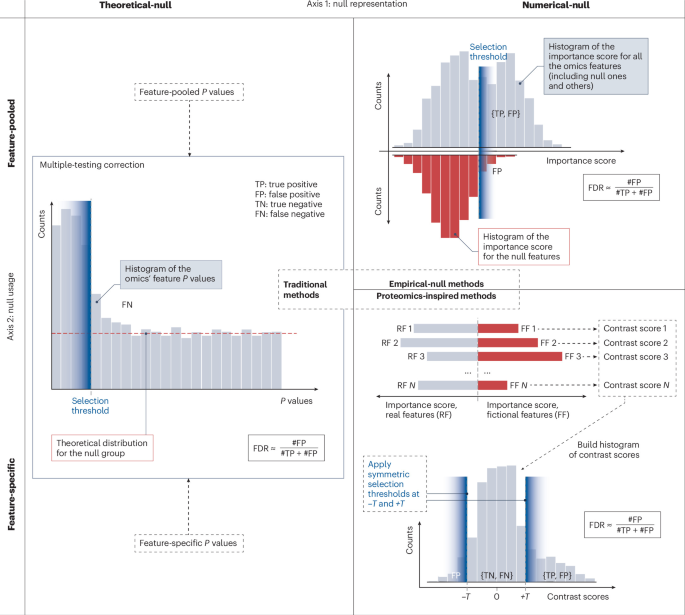
Researchers in genomics and proteomics often struggle with choosing the right statistical methods to avoid false discoveries. A recent Nature Biotechnology Comment proposes a 2 × 2 matrix to help scientists navigate these options. This framework helps researchers match their data and study design with the most rigorous statistical procedures available.
Original image temporarily unavailable
Background
In fields like genomics and mass spectrometry, researchers test thousands of biological features at once, creating a massive risk of false positives. While many statistical procedures exist to control the false discovery rate, they rely on different assumptions, making it confusing for scientists to choose the right one.
Details and Impact
To solve this, the authors propose a practical taxonomy organized around a 2 × 2 matrix. According to the authors, this matrix is designed to guide researchers in sequencing-based and mass-spectrometry-based omics. It helps them select either the most appropriate family of false discovery rate procedures or alternative, more rigorous methods tailored to their specific experimental setup.
View selection rationale
Importance 14/100
About this brief
- Content type
- Research summary
- Source type
- Publisher report
- Original source
- Nature Biotechnology ↗
- Source published
- Process
- AI-assisted discovery, translation, summarisation, classification and scoring; standards and corrections are maintained by the editorial desk.
- Verification
- The original URL and publication metadata are retained. This brief is not independently fact-checked unless explicitly stated.
- Published by
- Polyemergence Editorial Desk · PolyEmergence Pte Ltd.
- Conflict disclosure
- No financial or commercial conflict declared.