BrainGate Study Shows Utah Microelectrode Arrays Maintain Signal Stability for Decades in Humans
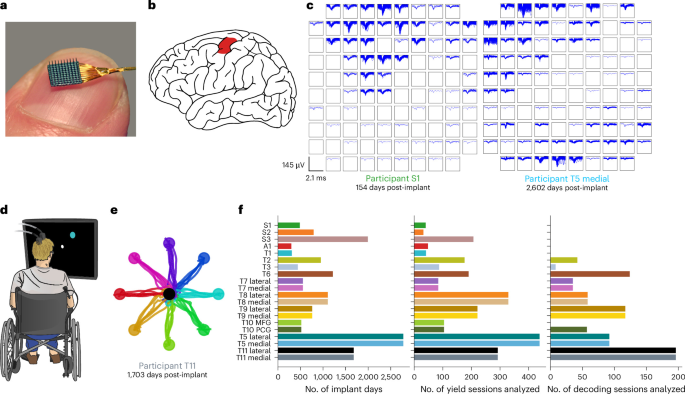
Researchers analyzed data from 14 participants implanted with Utah microelectrode arrays over a 20-year period as part of BrainGate clinical trials. The findings show that neural spiking activity and movement intention decoding can persist for multiple years with only a modest average decline.
Original image temporarily unavailable
Background
Brain-computer interfaces (BCIs) offer a promising path to restore movement and communication for paralyzed individuals, with many high-performing systems relying on silicon microelectrode arrays, specifically the 'Utah' array. However, most human studies have been limited to small case studies, leaving questions about long-term signal stability and individual variability unanswered.
Details
This post hoc analysis evaluated 20 arrays across 14 participants in the BrainGate and BrainGate2 trials between 2004 and 2019, spanning 2,289 recording sessions and 729 cursor-control decoding sessions. The team tracked array yield—the percentage of electrodes detecting neural spiking activity—along with decoding signal-to-noise ratio (dSNR) to measure movement intention decoding quality over time. Results showed a modest 7 percentage point average decline in yield over time, dropping from 41% in the first 3 months to 34% in the last 3 months, though considerable variability existed across participants.
Impact
Over 50% of arrays maintained at least 20% yield over the first 3 years, outperforming prior nonhuman primate benchmarks. Furthermore, high-performing arrays achieved movement decoding accuracy approaching that of able-bodied computer mouse control, demonstrating the clinical viability of long-term intracortical BCI implants.
View selection rationale
Importance 82/100
About this brief
- Content type
- Research summary
- Source type
- Publisher report
- Original source
- Nature Brain-Machine Interfaces ↗
- Source published
- Process
- AI-assisted discovery, translation, summarisation, classification and scoring; standards and corrections are maintained by the editorial desk.
- Verification
- The original URL and publication metadata are retained. This brief is not independently fact-checked unless explicitly stated.
- Published by
- Polyemergence Editorial Desk
- Conflict disclosure
- No financial or commercial conflict declared.