
Training a Scalable AI Agent for Economic and Geopolitical Forecasting
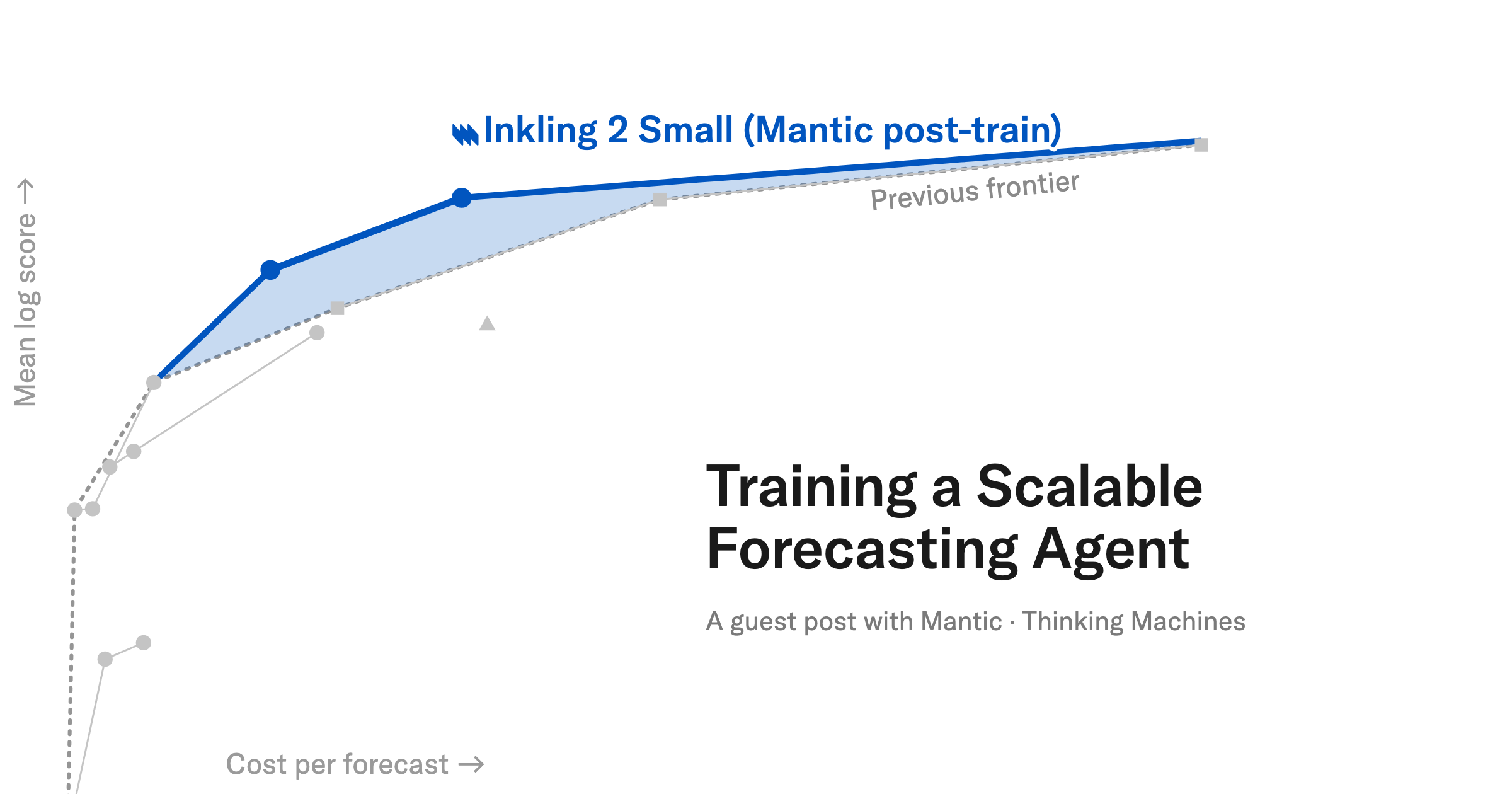
According to Thinking Machines Lab: Mantic and Thinking Machines report training an AI forecasting agent by fine-tuning Inkling 2 Small on the Tinker platform. The resulting model matches the accuracy of Fable 5.2 (medium) while being 15 times cheaper per forecast.
Original image temporarily unavailable
According to Thinking Machines Lab:
Mantic, in collaboration with Thinking Machines, details the creation of a scalable AI forecasting agent that handles both point-in-time research and probability distribution submissions in a single rollout. Built by post-training Inkling 2 Small on Tinker, the agent leverages asynchronous reinforcement learning via StableReinforce to scale across thousands of concurrent environments.
To address training bottlenecks, the developers tackled three major challenges. First, public forecasting platforms lack sufficient clean, high-stakes numerical questions, so they synthesized 45,000 quantitative questions from news using language models. Second, third-party APIs proved too slow for large-scale RL, prompting them to build dedicated low-latency databases, including a 1.32 TB point-in-time historical copy of Wikipedia. Third, because real-world forecasting rewards are stochastic, they introduced a blended reward function that mixes outcome log scores with expected log scores derived from frontier model reference ensembles.
Through training, the agent evolved from simple news-reading behavior into a quantitative analyst that runs dozens of tool calls, executes Python code, and models complex scenarios. The authors state this approach significantly extends the cost-accuracy frontier of automated forecasting.
View selection rationale
Importance 85/100
About this brief
- Content type
- News summary
- Source type
- First-party / official source
- Original source
- Thinking Machines Lab ↗
- Source published
- Process
- AI-assisted discovery, translation, summarisation, classification and scoring; standards and corrections are maintained by the editorial desk.
- Verification
- The original URL and publication metadata are retained. This brief is not independently fact-checked unless explicitly stated.
- Published by
- Polyemergence Editorial Desk
- Conflict disclosure
- No financial or commercial conflict declared.