What Is Eval-Driven Development? How to Improve AI Agents
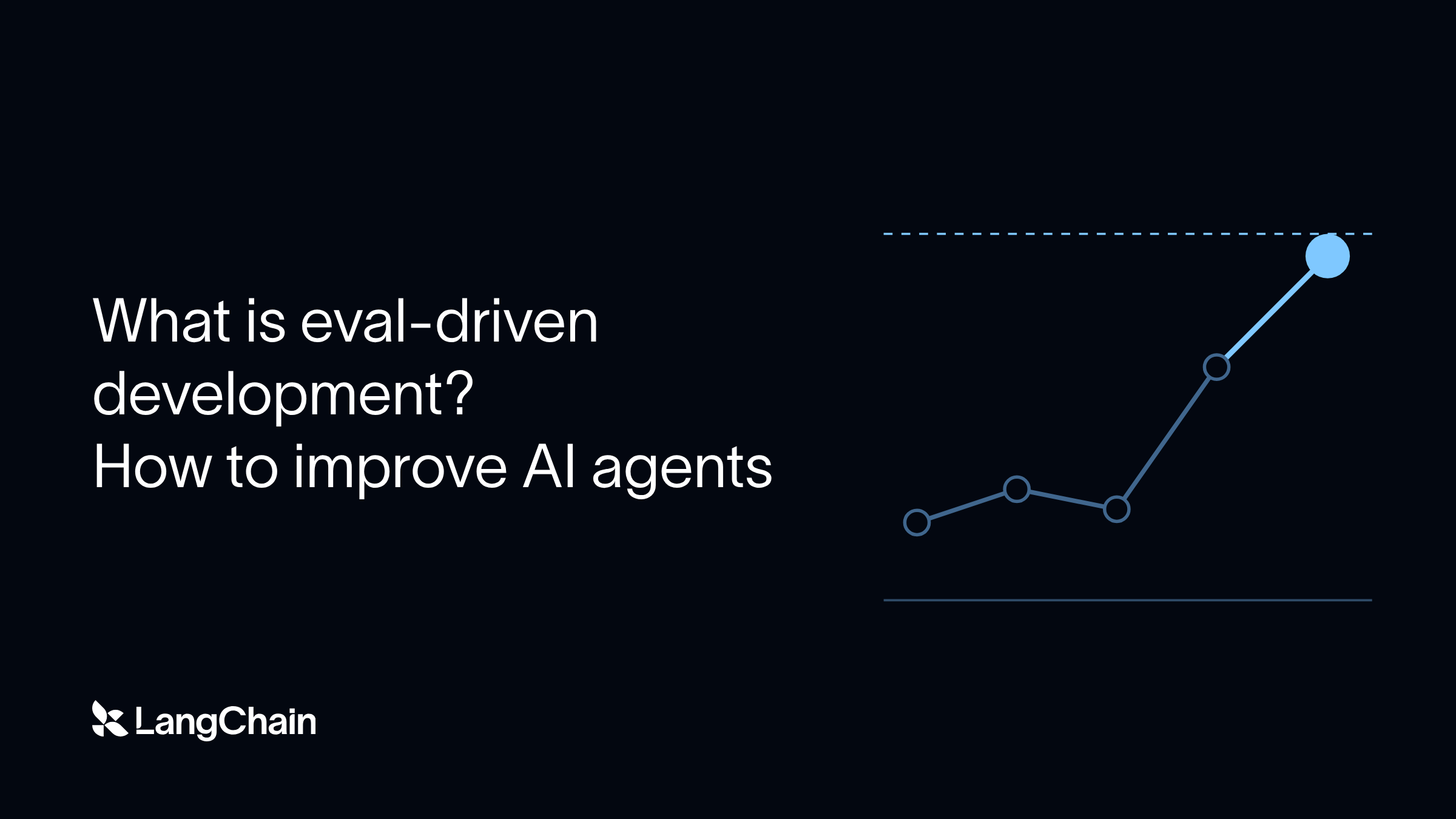
According to LangChain Blog: Eval-driven development (EDD) is a new method for building AI agents by measuring performance against a consistent set of metrics. Instead of guessing if a code change worked, developers write tests first and compare experiments to avoid breaking old features.
Original image temporarily unavailable
According to LangChain Blog:
When building AI agents, developers often struggle to know if a recent change actually improved the system. Eval-driven development borrows from traditional test-driven development to solve this unpredictability. The process has three main steps: defining success clearly, writing evaluations before building, and comparing experiments iteratively.
First, you create a short specification of what the agent should and shouldn't do. Next, you build a dataset of test cases, often using real user runs or synthetic data, and create evaluators using code or LLMs. Finally, you run a baseline, make your changes, and compare the side-by-side results to catch regressions and prevent overfitting.
View selection rationale
Importance 84/100
About this brief
- Content type
- News summary
- Source type
- First-party / official source
- Original source
- LangChain Blog ↗
- Source published
- Process
- AI-assisted discovery, translation, summarisation, classification and scoring; standards and corrections are maintained by the editorial desk.
- Verification
- The original URL and publication metadata are retained. This brief is not independently fact-checked unless explicitly stated.
- Published by
- Polyemergence Editorial Desk · PolyEmergence Pte Ltd.
- Conflict disclosure
- No financial or commercial conflict declared.